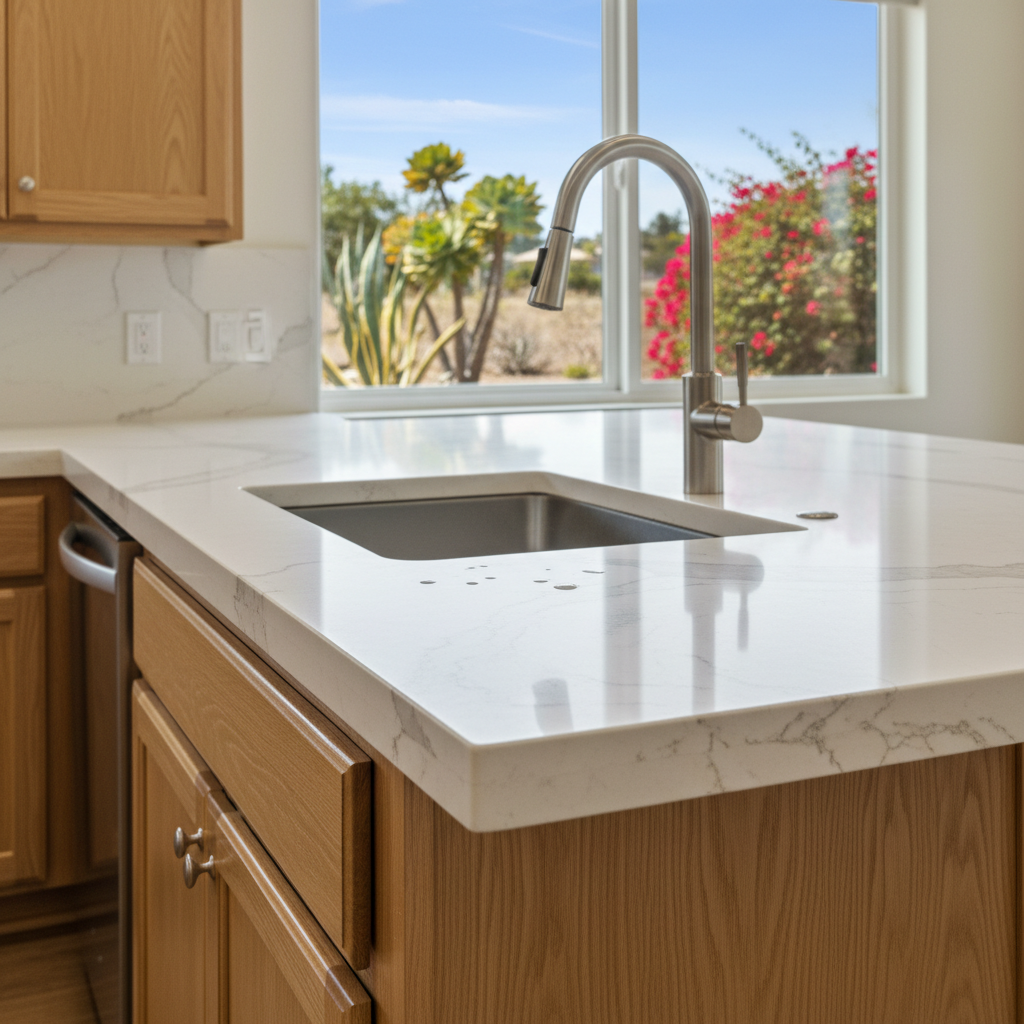
What's the best countertop material for my kitchen?
Honestly, there's no single "best" material that works for everyone. It really just depends on how you use your kitchen, your budget, and the look you're trying to achieve. I've seen folks in Eastlake North who cook every single night, chopping and dicing like a professional chef. For them, something super durable like quartz or granite is usually the smart choice.
Quartz is an engineered material, so it's non-porous, resists stains, and never needs sealing. Granite, on the other hand, is a natural stone. It's incredibly tough, but you do need to seal it every so often to keep stains from setting in. Both are fantastic for kitchens that see a lot of action.
Then you've got people who just love the natural look and feel of marble or quartzite. Marble is gorgeous, absolutely no doubt about it, but it's softer and more likely to etch or stain. You'll definitely need to be careful with acids like lemon juice or wine. Quartzite gives you a similar look to marble but is much harder and more durable, almost like granite. It's a great compromise if you want that elegant veining without quite as much fuss.
Laminate is still around, and wow, has it come a long way! It's budget-friendly and offers a huge variety of patterns, even ones that mimic stone. Now, it's not as durable as stone or quartz, but for a rental property or a kitchen that doesn't get heavy use, it can be a really smart pick. Wood butcher block is another option that adds warmth, but it needs regular oiling and can show wear more easily.
My advice? Think about your lifestyle first. Do you entertain often? Do you have kids who are rough on surfaces? Are you a meticulous cleaner, or do you prefer low-maintenance? Answering those questions will narrow it down fast.
How long does countertop installation actually take?
This is a big one, and people often misunderstand it. The actual installation of the countertops themselves usually happens in just one day – maybe two for a really large or complex kitchen. But that's just installation day. The whole process, from the moment you pick your material to the finished product, takes longer, you know?
First, you have to pick your slab or material, which can take a while if you're indecisive (and that's perfectly fine!). Once you've made your choice and placed an order, we come out to do a precise templating of your cabinets. This usually happens after your old countertops are gone and your base cabinets are fully installed and level. We're talking digital measurements here, super accurate.
After templating, it typically takes about 1-2 weeks for us to fabricate your countertops. This is where we cut, polish, and shape the edges of the stone in our shop. During this time, your kitchen will be without functional countertops, so you'll definitely need to plan for that. Once fabrication is done, we schedule the installation. So, from template to install, you're usually looking at 2-3 weeks. Don't let anyone tell you it's a weekend job from start to finish if you're getting stone or quartz.
Do I need to remove my old countertops myself?
You *can*, but I generally don't recommend it unless you're really handy and know what you're doing. Removing old countertops, especially tile or solid surface, can be messy and sometimes tricky. You could damage your cabinets, plumbing, or even yourself if you're not careful. There's also the issue of disposal – those old countertops are heavy and bulky, and you can't just toss them in your regular trash.
When Heritage Kitchen Solutions handles your countertop installation, we include the removal and disposal of your old countertops as part of our service. It just makes the whole process smoother and ensures your cabinets are prepped correctly for the new ones. It's one less headache for you to worry about during a remodel.
What about sinks and faucets? Who handles those?
This is a crucial point you should clarify upfront with any installer. For our projects, we typically handle the installation of the sink itself – meaning we'll mount it to the underside of your new countertop (if it's an undermount) or drop it in (if it's a drop-in style). We also cut the holes for your faucet and any other accessories like soap dispensers or hot water taps.
However, we are not licensed plumbers. So, while we'll set the sink, you'll need a plumber to come in afterward to reconnect the water lines, drain, and garbage disposal, and to install the faucet itself. We can often recommend local plumbers we trust if you don't have one. It's important to coordinate these schedules so your kitchen is fully functional as quickly as possible. Usually, the plumber comes in the day after the countertop install, or sometimes even the same afternoon if they're available.
Will my cabinets be strong enough for new stone countertops?
That's a very good question, especially with how heavy natural stone or quartz can be. Most standard kitchen cabinets are designed to support the weight of typical countertops and everyday kitchen items. However, if your cabinets are very old, flimsy, or show signs of water damage or structural issues, they might need some reinforcement or even replacement before new stone countertops go in.
When we come out for templating, we'll always inspect your existing cabinets. If we see any issues, we'll let you know right away. Sometimes it's just a matter of adding some extra bracing; other times, it might point to a bigger problem. You definitely don't want to put heavy stone on unstable cabinets – that's just asking for trouble down the line. We'll make sure everything is solid before we proceed.
How do I maintain my new countertops?
Maintenance really depends on the material. For quartz, it's super easy. Just wipe it down with a mild soap and water solution, or a non-abrasive cleaner. Avoid harsh chemicals or abrasive scrubbers, and you're good to go. It's pretty much set it and forget it.
Granite and quartzite need a bit more attention. You'll want to seal them periodically, usually once a year, sometimes more often depending on the specific stone and how much use it gets. Sealing helps prevent stains. For daily cleaning, again, mild soap and water is your best friend. Avoid harsh acidic or alkaline cleaners, as they can strip the sealant or etch the stone.
Marble needs the most care. It's porous and reacts to acids, so wipe up spills immediately. Use cutting boards and trivets religiously. For cleaning, stick to pH-neutral cleaners specifically designed for natural stone. If you're okay with a 'patina' developing over time, where the stone shows signs of life and use, then marble can be a beautiful choice. If you want it to look pristine forever, it might not be for you.
For all materials, I always recommend using cutting boards and hot pads. Even the toughest stone can be damaged by extreme heat or sharp knives. A little common sense goes a long way in keeping your investment looking great for years.